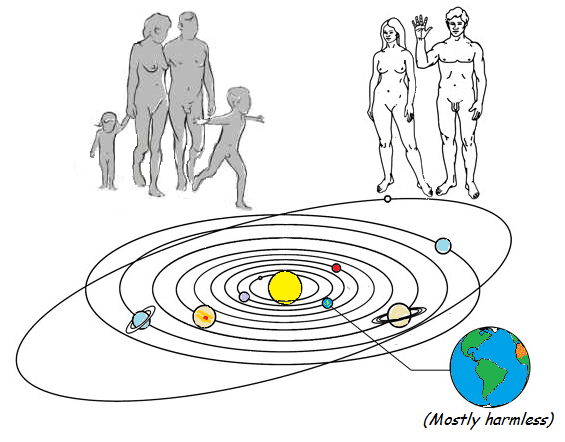
In keeping with my self-appointed mission -- to educate non-naturists to understand that the state of nudity is the natural state of humankind -- I present here a link to a powerful and sympathetic essay originally found on tripod.com. The page, the page, Naked Spirit, was not maintained for many years and some of its external links had passed out of existence. But, it is such a very good essay; I truly wish that I had written it myself. So I worried about its loss should the page itself disappear.
This finally happened in April 2026 when Tripod closed its doors and shut down all of the websites it had hosted. Lucky me, I had copied the text and images so that I could repost it here. I don't know who wrote it but he/she was very good. I wish that I could attribute it, but I can't.
In the meantime I ask you to read it. It is quite long, very cogent and genuinely moving. It is well worth the time spent reading it.Enjoy!
NAKED SPIRIT

"We are by nature all as one, all alike, if you see us naked..." John Burton (1576-1640)
The relationship we have with our bodies is a strange one, shifting precariously between fascination and loathing. We know the body is the seat of life just as the spirit is the spark of life, and yet a great many of us can't fully grasp this.
We need to recognize that the body and the spirit are not separate but parts of the whole self. The only way for this to be possible is through acceptance of who and what we are. If we can't accept our bodies in their totality we can't experience the totality of our being, and we will remain divided and mired in spiritual, emotional and physical conflict. Our nakedness compels us to deal with our nature and the forces which shape us and carry us along through our lives.
Innocence
In many cultures around the world, the human body has not been an object of shame to the extent it has in our society. Many peoples, prior to exposure to "Western" values, have simply lived naked, if their climate permitted, or wore a modicum of decoration. As missionaries covered the globe, this began to change. The message of shame and modesty has forced clothing on people who have virtually no need of it. With childlike trust they listened to the bearers of the message that equated nudity with sin. Sometimes these changes, along with changes in diet and social structure have had unfortunate results.
As the missionaries "helped" the so-called "primitives", we moderns have taken upon ourselves to condition small children who come into this world with no concern about their unclothed state to feel embarrassment or shame. From the start they are not at all self-conscious about being naked — in fact they would usually prefer being nude if given the chance. But often they aren't allowed that freedom. They must be taught to fit in with the rest of us.
Innocence and it's loss are themes which reverberate through cultures around the world. The banishment from Eden is more than a myth. It is a reality that plays itself out every day. And the scars this process leaves are incalculable. Nevertheless there are ways to heal the wounds of guilt and shame which fester beneath the facade of propriety and self-deception. There is a way to return to the sacred grounds from which our spirits sprang in the bright yesterday which we often choose to forget since the sense of loss is too great to bear. We have to learn to honour the child within — to become, in fact, children in spirit. Only by returning to the fertile lands of imagination and open-hearted trust can we find ways for our souls to grow beyond the calcified confines within which time and cynicism have encased them.
We must, in short, reverse the process which has brought us closer to death and left us languishing in the coldness of our own ruinous logic. For while our minds have and will continue to serve us and show us the way through life, it is only when we allow our hearts to be partners in the process that any of this will have any meaning at all. With a new awareness of love and goodness — the integral elements of the innocence so many of us have lost — we can restore ourselves and give our children the kind of guidance which might help them avoid the mistakes we've made. Entering the world with such an attitude of truth takes courage, perhaps more courage than is required for anything else we do. Not doing so, however, is the signal to us that hope has ended and our lives have lost their meaning and purpose. We have the potential to take the step — it's just a matter of doing it.
Purity


"When a child runs naked through a field of grass, she is not, at that moment, preoccupied with the ways of the world. She is free and unhindered, able to experience life in the most direct way possible."
Freedom ... this is a word that is bandied about to the point where it becomes more of a cliché or an icon than a state of existence we actually experience. Yet it is something that remains a part of us once we've tasted its sweetness. It is a kind of clarity of being — a state of purity which allows our souls to soar and presents us with a vision of a life without limits. It is the ground state of our being — the initial kernel of awareness which blesses us before we learn to "know better".
When a child is born he is a clean slate. While certain instincts and drives exist which are necessary to his survival, his opinions and assumptions are yet to be formed. He knows pain and pleasure, but in their purest and most undifferentiated states. He hasn't had a chance to tie these apprehensions to specific circumstances, but soon he learns how. Yet as that process begins and progresses, the young child remains happily unaffected by many of the weightier concerns of his parents and other adults.
For a child the separation between himself and the world is only beginning. Everything appears joined to his experience of it — subjective and centred in his own perception. He learns good and evil on a visceral level. Things which cause pain are to be avoided and things which cause pleasure are to be pursued. He navigates through the world using this compass, unaware to a great extent that the body which is the receptacle of his life and feelings is not simply another particle of the great mystery that surrounds him. It hasn't yet become fully his own.
Experiences of his own actions and accountability accumulate, however, and he begins to learn responsibility. These are things which become his own, exclusive of others. His body as well is more and more seen as something which he must look out for and protect. While his mother and father may still oversee him, his increasing independence takes him further afield and increases the risks to life and limb.
It is in this dim time that his body goes from being an instrument of his life to a thing which belongs to him. Increasingly he must take on the task of caring for it. He must cover it and see to its needs. As this process takes place he does not immediately perceive all these things or carry them out as he should. It is a burden after all to own a body. It is a thing which needs to be fed, groomed, cleaned, and kept from harm's way. It must be controlled and conditioned to do the things its master demands. And it doesn't always cooperate.
In time a child learns that the body has about it aspects which others view as distasteful or unpleasant. One of the things he must do is make sure those things are kept under wraps and out of sight. This might not make a great deal of sense to him, but it must be done this way. The pure, clear, uplifting experience of simply being alive becomes tainted by a growing perception of the evil aspects of the very thing which is the medium of life. This realization eats away at his heart, undermines his faith in the basic goodness and simplicity of the world and leaves him feeling like a stranger in his own skin. It is the pure becoming impure. It is the first whisper of evening at the very morning of a young life.
When a child runs naked through a field of grass, she is not, at that moment, preoccupied with the ways of the world. She is free and unhindered, able to experience life in the most direct way possible. It is only when an adult tells her that she is wrong to do this and fills her head with vague and ominous warnings that stain her appreciation of the moment that her happiness withers and comes back a little less powerfully the next time. There are few sights more exemplary of sheer, unselfconscious elan than the picture of a naked child unashamed and matter-of-fact, moving through the world as if it is her home. There are no other motives in her mind, no distracting, sly seductions ticking away in her virginal heart — just the pure happiness of being what she is.
For many adults such joy is lost to them. The world has betrayed their dreams too many times to succumb to such delusions. And for them the sight of a naked child only awakens apprehension. They, with good intentions, fear for her and the harm that might befall her. They know too much of the evil ways of their fellow human beings and are too aware of the predators who would ruin the very innocence they seek to protect. These crestfallen ones are very admirable in their own way. They seek to preserve something lost to them for as long as is humanly possible. But in doing this they create about them and their children an aura of anxiety where evil may not do its worst but still creeps into their hearts like a poisonous fog. The innocent are forced to surrender certain precious aspects of their innocence. They cannot run naked through the grass on a summer's day. They cannot smile at someone they do not know — not with the fullest trust they are entitled to experience.
We must be wary of undermining the purity of a child's heart in our attempts to preserve it. Certainly there is evil in the world and it must be kept at bay. But it may be far better to instruct our children that evil is never more powerful than the simplicity of a kind heart and a gentle smile. We must teach them to avoid harm, but we must not do so in such an extreme way that they are paralysed with fear and guilt. If evil befalls them despite our best efforts to protect them, we must have faith that the healing power of love will rescue them from the toxins which pollute our world and heal them so that they may still experience the essential purity which remains in the hearts of even the most corrupt. We must let them run naked through the grass so they can show us how it's done — in the spirit of guiltlessness and freedom which only the youngest among us know in its purest form.
Joy

"The smallest of children live in the glow of joy because they trust in the life they've been given."
"When we clothe ourselves and banish our basic humanity to an oblivion of forgetfulness, we have cut ourselves off from much of our joy."
The most precious gift of life is the untrammelled sense of pleasure we feel -- when all the world seems balanced and harmonious. It may only last a moment, but it's moments like these that help to give us the strength to persevere through darker times. The root of joy in our life rests on a sense of belonging -- a feeling that we are perfectly enmeshed with the world and its glories. Joy is rooted in the simplicity and clarity of faith in the basic goodness and generosity of life. We are, after all, merely emanations of the vital urge manifested all around us in the form of plants, trees, animals and other human beings. To be born - to come into being - must be seen as a gift.
In the artlessness of a child's mind, life is as mysterious and elusive as it is for the wisest of sages. For the child, however, the experience itself is what matters most -- not the way in which it came about. Children may have goals and they may scheme to attain things that they think will give them pleasure. But it is in the spontaneous moment that they find the joy they seek. While they gradually adapt to the plotting ways of adulthood, they can still let go and simply live.
The smallest of children live in the glow of joy because they trust in the life they've been given. They let responsibilities and concerns fall into the laps of adults and only worry when it dawns on them that a beloved parent is mortal and may disappear from their lives. This is not to say that a child's life is one of endless bliss. Perhaps it is better understood as one where life can be lived in the moment to it's fullest -- whether in pleasure or pain. And while in our youngest years we flexibly move from pole to pole with little anxiety as to how long it will last or when we shall have it again, time eventually burdens us with a sense of these things. We become all too aware of the consequences or our actions and the formulas by which we may attain the things which in the past have given us pleasure.
Caught up in the churning of such considerations, the clarity and beauty of simply being becomes shrouded in layers of speculation and conjecture. The joy of just being becomes the satisfaction of watching the well-designed machinations of our lifelong plans ratchet through their motions. Ideas and feelings are appropriately compartmentalized and desires dutifully deferred until the optimum instant. Joy is then not an experience that flows easily from one moment to the next but a discrete package of complacency yielded to us by a begrudging world as a well-earned reward.
Setting ourselves and our time apart we lose the continuity and vital sense of connection. There is a time and place for everything, and enjoyment exists quite apart from the struggles of our labour. Through all this our basic needs are bound up in the packaging and put into boxes to be opened when its more convenient. Our extraneous senses -- those feelings which are not necessary to the accomplishment of our goals -- are not simply of no use but actually interfere with our efforts. We must learn to put them aside and out of sight lest the distract us and throw us off our timetable.
The body, however, is more than a tool. It is an integrated part of what we are -- inseparable and absolutely essential. If we ignore it or shun it because it doesn't fit in with the plan we deprive ourselves of something which in the end we cannot do without if we really hope to experience the fullness of what life has to offer. When we clothe ourselves and banish our basic humanity to an oblivion of forgetfulness, we have cut ourselves off from much of our joy. We have divided ourselves into parts that we may show the world and parts that we may not. And through this fragmentation we cripple ourselves and cease to be the sum of all those different aspects.
Perhaps it is best to think of joy as a kind of nakedness of the spirit when the sunlight and authenticity of our world can touch us without fear and apprehension. To denude ourselves of the trappings of our minds and thoughts allows us to really feel things more directly and take in the nourishment of the true nature of things. And in many ways joy can also be seen as the childhood of the soul when it is permitted to bask in the glow of its very innocence and expand beyond the confining boundaries imposed by our limited ideas. It is through joy that we embrace life rather than shrink away from it. It is through joy that we remove the barriers to the fullness with which anxiety and despair enshroud us.
Nakedness may be seen as merely a metaphor in that sense, but it may be wiser to appreciate that the physical state of being - the acceptance of ourselves in our totality - is a necessary component in our spiritual and mental growth. To be capable of such growth we must remain in a state of naked childhood - open, trusting and even vulnerable in many ways. We can look to the youngest members of our world to teach us these lessons which too many of us seem to have forgotten. We have too easily accepted that because there are hazards in the world we must remain perpetually focussed on those dangers, not realizing that in the process we are damaged in ways that are more debilitating than whatever we tried to avoid.
Even if our hearts have closed themselves off and we have lost the spark, we can regain it if we give ourselves the chance. It's just a matter of letting go and releasing the fear that holds us prisoner. The truth is we must become as children again - we must shed the literal and figurative clothing of our grim, serious lives and melt carelessly into the ocean of life which surrounds us. That is the way to joy and the way to living life as it was meant to be lived - as we were born to it.
Transitions

"Unless they are brought up in a family which accepts nudity, small children become savvy enough to realize that nudity is unacceptable and is even a source of embarrassment."
"The body itself is not wicked - only the ways which it might be used to hurt others"
Something happens to us as we grow older. The light in our eyes begins to fade a little and our ease of movement through the world lessens. The process is slow and gradual, but it is inexorable. In that twilit realm between childhood and adulthood, the erosion of hope and happiness takes its toll in convulsions of distress and the glum depression of adolescence. There is an increased sense of guardedness -- of covering up feelings and vulnerabilities that is exemplified by our attitudes towards our own bodies.
Very young children have no compunction about being nude. Often they will prefer this to the frustration of many a parent who must chase these naked sprites and keep them dressed. Depending on the way we are raised, this generally begins to change by the time a child reaches four or five. Unless they are brought up in a family which accepts nudity, small children become savvy enough to realize that nudity is unacceptable and is even a source of embarrassment. They take their cue from worried parents, disapproving onlookers and the derisive laughter of their peers. A whole network of reinforcing doubts corners the child into believing that his body is a source of shame that ought to be kept from view.
There are those, however, who seek to raise their children to view themselves differently. They realize that treating the body as an object of disgrace drives a wedge between a child and the very vessel of his life. The schism of such an attitude creates within children and adults a low-grade sense of self-loathing and unworthiness which can translate into a variety of problems within them and in their interactions with others. Those parents who are aware of the ramifications of this alienation try to find ways to relieve their children's concerns, and one important way is to allow nudity within the family or even among other families who are sensitive to these things. Nudism and naturism came about -- at least in part -- to stem or reverse the deterioration of humanity's estrangement from the human body. When children are raised with a sense that there's nothing fundamentally wrong with what they are, they have a better chance of avoiding the pitfalls of body loathing and fear which is so prevalent in our society.
But a time comes in the life of a child -- quite often even one raised with a healthy attitude about herself and her body -- when the opinions of others and certain doubts conspire to undermine her self-confidence. As a girl becomes more integrated into the society at large and begins to seek her place in it, she relies less on the support and beliefs of her family and more upon the views of those around her -- particularly her peers. At the same time she begins to experience a certain amount of anxiety about her transition to adulthood. She worries whether she'll be attractive to others and accepted into the group. Concerns about the shape and development of her body replace the more carefree attitudes of earlier childhood.
At this stage there is very little a parent can do to comfort or ease this transition for her son or daughter. The comforting wisdom of a mother or father cannot take the place of teenagers friends and the inordinate influence they have on his life. If he is surrounded by others who are embarrassed or titillated by nudity he will find it hard not to react the same way. Boys and girls both suffer from the comparisons that might be made concerning the rapidity of their physical development. They would prefer to be spared such ordeals if possible and shy away from circumstances where they might be made.
Even as young people emerge from this tumultuous period of their lives, the scars often remain. Being shunned -- or simply fearing ostracism -- leaves a legacy of uncertainty and a poor self-image. It has been said that modern society lacks a means by which it's younger members may smoothly incorporate themselves into the mainstream. Whereas rituals and observances of initiation -- often in the early teens -- were and are common in certain cultures, the amorphous realm of adolescent society which children must navigate places them in a kind of void where they neither belong wholly to their parents nor wholly to the world at large. This is unfortunate and a byproduct, perhaps, of the diminution of the role of communities and the domination of the nuclear family (versus the extended family and neighbourhood). Children ought to feel that they belong to the world and are accepted by those around them so that when they stand on the threshold of adulthood they can assume their roles with little, if any, difficulty.
Part of the process of encouraging or maintaining this sense of belonging relies upon our teaching children to accept themselves and each other. We ought not label certain parts of our bodies as evil or treat them as though they are something that must be kept secret and covered out of a sense of shame. The body itself is not wicked -- only the ways which it might be used to hurt others. By distinguishing between those parts of us which have traditionally been viewed as impure and certain behaviour which could be offensive under the wrong circumstances we make an important distinction that doesn't tar innocence with certain kinds of associated behaviour. Such distinctions may be lost on most children and some adults as well. Accepting ourselves and our bodies as natural and neutral - neither good nor evil - helps younger minds see the difference between the body and the way it might potentially function.
With the loss of innocence and trust comes a loss of childhood. But how much of that loss is necessary, and how much takes place because we allow fear to dominate our lives? And what is the source of that fear but a falling away from the joy and sense of connection with our origins -- our own parents and the life force itself? The transition to adulthood is unavoidable and even essential. But the loss of all those positive qualities of childhood is nothing short of a tragedy. We must teach our children and ourselves to preserve or regain them or risk living a hollow, meaningless life of suffering and despair.
Fear
"When a person's or society's qualms are no longer aligned with the observable, a far more serious condition exists than that which is itself feared. It has become an irrational phobia that can no longer be addressed with reasoned arguments or indisputable facts."
"Simply being nude doesn't mean acting out the potential sexual behaviour which too many people assume nudity to be a prelude to."
"The attitudes which prevail in our culture regarding sex and nudity seem fairly intractable, and yet human history is replete with examples of different approaches to these conditions."
Because of the way we have been conditioned to see things, there is a tendency to assume that the state of being dressed -- especially in the company of friends or strangers -- is the natural and appropriate way for people to be. Many people simply feel this is a sensible, moral and practical approach. What they overlook is the fact that compulsion to wear clothes is a conditioned response, brought about by certain cultural assumptions and biases. Likewise the fear or avoidance of nudity -- one's own or someone else's -- is something that must be learned as well.
But once it's learned it is difficult to unlearn. The barriers that fear sets up in our lives are enormous and self-perpetuating. The very paralysing quality of feeling apprehensive and anxious about ourselves and our status keeps us from seeing the possibilities which exist beyond this state of mind. Based on our need to defend ourselves against attack, the instinct of fear is a very valuable ally as we face potential dangers, but it can also be a merciless oppressor, keeping us from straying beyond the fortification of our own devising, so that those protective walls become a prison.
Breaking the pattern of fear can be a lifetime effort which few (if any) of us successful achieve. Yet we must continue to do what we can to tear down the walls that separate ourselves from each other and a richer life that we cultivate once we step beyond the confines of our fear. Because fear is often more a product of conditioning -- the accumulated lessons taught to us by those around us and the fallout from numerous negative experiences -- we must go deep within our own minds to really root out this demon. We must face it directly, exposing ourselves to its toxins and risking an even deeper retreat into its dark labyrinth. This risk, however, is certainly worthwhile in the long run, for if we persevere we will find a new kind of freedom which would otherwise lie beyond our reach.
Once we conquer or at least subdue our fears we find that we can involve ourselves more fully in life and begin to develop more intimate and long-lasting relationships with other people. And once that process begins, another self-perpetuating dynamic begins to takes its place. If many of our fears are rooted in a need to protect ourselves, the alliances and friendships which we begin to build as fear dissolves make it less and less necessary to adopt this defensive posture. Something else begins to displace our apprehension -- something called love.
Temptation

"When a person's or society's qualms are no longer aligned with the observable, a far more serious condition exists than that which is itself feared. It has become an irrational phobia that can no longer be addressed with reasoned arguments or indisputable facts."
"The attitudes which prevail in our culture regarding sex and nudity seem fairly intractable, and yet human history is replete with examples of different approaches to these conditions."
It's an undeniable fact that most people have a problem with nudity -- if not, why are there laws against it? The exposure of certain parts of the human body is proscribed in many societies throughout the world. Those who concoct or uphold such laws do so out of a sense that somehow the unadorned epidermis is a threat to the common welfare. Those laws, in most cases, insinuate that when specific portions of the anatomy are visible, it's considered a form of sexual activity.
Let's face it: The fundamental resistance to and reaction against nudity by a great many people involves discomfort regarding the sexual aspects of those body parts which according to custom must be concealed. For the most part most of the human body is considered fairly neutral in the Western secular societies. While Islamic cultures still require women to cover a great deal of themselves, this generally goes against a trend throughout the rest of the world. At one time Europe and European offshoots (such as the US, Canada, Australia, and Latin America) were nearly as fastidious about keeping women under wraps but this has changed radically through the course of the 20th century. The last frontier of human exposure, however, are those components which clearly demarcate the differences between the genders. While many countries in Europe have relaxed these requirements and nudity on beaches throughout the continent has become more commonplace, a certain stigma remains, particularly in the US, which limits those who would accept and practice public nudity to a small, beleaguered minority.
Why does this resistance continue? Is the exposure of sexual differences really the same thing as acting upon them? There is a fear, no doubt, that public nudity is a precursor to public debauchery, even though such behaviour is fairly rare at beaches where nudity is permitted. Yet in the hearts of those who are apprehensive about such nudity lurks a deeper anxiety, I suspect, that the constant interaction of nude people of the opposite sex will cause a certain level of tension or excitement to build which will result in an increase of promiscuity and the ultimate collapse of morality throughout our culture. While such fears are understandable and even arguable, they seem to be well out of proportion to the actual conditions which prevail in societies that are more tolerant of nudity. When a person's or society's qualms are no longer aligned with what is observable, a far more serious condition exists than that which is itself feared. It has become an irrational phobia that can no longer be addressed with reasoned arguments or indisputable facts.
Though the phobia itself directly deals with nudity, the attitude appears to spring mainly from a fear of sex -- or more specifically a fear of the ramifications of sex and society's reaction to it. There are many understandable causes for this fear. Sexuality is a powerful drive with serious consequences. Because of the potential implications and the central role it serves both in our instinctual and social lives, sexuality has come to be ritualized and regulated with powerful and often sensible taboos. But as with anything that is restricted and reined in, the struggle to control and curb sexuality yields a variety of reactions, most of which carry a great deal of negative baggage. On the one hand there are those who effectively repress their sexuality but do so at the cost of becoming aggressively oppressive of any outward sign of sexual expression. And then there are those who are compelled to rebel, thumbing their noses at the established order and submerging themselves in a kind of sexual abandon.
These extremes work off each other and play themselves out in a kind of perpetual battle of wills. The prudes and the libertines need each other to justify or energize their respective positions. Caught in the middle are those who would reasonably suggest that sexuality is an integral aspect of human experience but at the same time shouldn't be treated as a hobby or a form of recreation. Most importantly it should not become such an obsession that it colours every aspect of our lives in stark and garish hues one way or the other. Both the prude and the libertine tend to see it everywhere in a form that is crude and simplistic. A more natural, relaxed way of dealing with it would reveal it to be something that should neither be completely repressed nor exploited. It is a force that must be respected and even valued for what it means to us personally and as part of our lineage as living beings. When it is enjoyed privately between two people it is fulfilling its highest purpose since that purpose is both procreative and interpersonally bonding. When it is made public and coarsened by those who suffer from compulsions which emerge from undue repression, it becomes ugly and toxic.
The great difficulty of dealing with sex is its private nature coupled with the enforcement of this privacy. Children can be taught to appreciate the importance of retaining the intimate element of sexuality without branding it with the label of sin. Adults can see how special a relationship which expresses the tenderness of their sexuality can be without banning it to the oblivion of "one of those things we just don't talk about." Part of a more relaxed approach that doesn't lurch into total abandon ought to include an acceptance of our bodies for what they are and our ability to be what we are in a variety of settings. Simply being nude doesn't mean acting out the potential sexual behaviour which too many people assume nudity to be a prelude to.
The attitudes which prevail in our culture regarding sex and nudity seem fairly intractable, and yet human history is replete with examples of different approaches to these conditions. The current error of automatically viewing nudity as a component of the sexual experience, however -- which overlooks how we might be nude in a variety of settings which are non-sexual in nature (doctor's offices, same-sex changing rooms, etc.) -- unfairly tars the nude body with a stigma of provocative promiscuity. To change these attitudes we must learn to look deeper into these things and into our own hearts. In the process we may discover the unexpected.
Conformity

"When we choose to run with the pack and cleave to the herd we may feel secure and safe, but by doing this we may be giving up or suppressing some important part of ourselves which is vital to our existence."
"At some point we must find a way to honour that part of us we hide from the world. It is not a demon we struggle with but actually the very essence of our own lives."
"We must be willing to stand naked before the world and learn through this experience that the withering gaze of even our harshest critics cannot undermine the strength of our resolve and the persistence of the human spirit."
Human beings have been from the beginning very social and extremely dependent on the support and aid of each other for survival. Throughout our long childhood during which we gradually learn to integrate ourselves into society we are always taking stock of our place in the scheme of things. We measure our self-worth against standards others set for us, we test our abilities against the achievements of others and the very language we use amongst ourselves and within the privacy of our own minds is the construct of hundreds of generations of minds that went before us. We are in essence made up of the bits and pieces of lives that have gone before us which makes it very difficult for us to find anything about us that is unique and original.
And yet we are truly more than the sum of our parts. Despite the fact that we are made up of borrowed dreams and ideas, the way in which those elements combine is unique. There are so many different influences that impact on us -- so many that are contrary and pulling us in different directions -- that at many times in our lives we must make difficult choices as to which paths we must follow. When we choose to run with the pack and cleave to the herd we may feel secure and safe, but by doing this we may be giving up or suppressing some important part of ourselves which is vital to our existence. It's necessary for us to recognize the rare and precious aspects of ourselves to truly derive the most satisfaction and fulfilment from life.
The tug of war between our "urge to merge" with the mainstream and our need to express our individuality can take its toll. Generally we are more prone, due to conditioning and even instinct, to go along with what others want. We often conceal our true wishes and desires just to avoid making waves. We fear that others may think we are odd and/or unworthy of friendship or trust if we reveal some part of ourselves which may seem eccentric or out of step with the majority view of what is proper. This can manifest itself in many different forms. Perhaps there is a certain body type that is considered attractive or fit, and to not fall within the parameters of that type is to display a lack of self-discipline or dedication to a particular objective. Or maybe we may find pleasure in certain activities that, while not outright immoral or threatening, still carry some taint of outlandishness that would estrange us from others -- or at least would hold the potential to do so.
It is for this reason that we hesitate to unmask ourselves and go naked into the world -- literally and figuratively. We cower behind the walls of propriety and hope that no one will discover our "dirty" secrets. We trim our behaviour to fit the blueprint which all decent people use to construct their lives. And in some ways we grow to loathe the inner man or woman who wants to break free -- who torments the obedient boy or girl face we present to the world -- and put an end to the charade. Within so many of us this battle rages over the course of a lifetime, compelling us to remain quiet but often emerging in ways that would imperil our good standing in the community. What we gain through this struggle is so meagre compared to what we lose in the long run. We are half-people -- really less than half -- and the dull ache of such a life causes many of us to question whether such a life is worth living at all.
At some point we must find a way to honour that part of us we hide from the world. It is not a demon we struggle with but actually the very essence of our own lives. It becomes demonic through contention, however, and it's destructive power ought not be underestimated. If we allow our uniqueness to shine through -- and by this I don't mean the urges which ferment in the darkness of our souls, but the tender and warm feelings which we bury beneath a harsh, supposedly strong exterior -- the darker forces will not prevail. They will, instead, lose their power and even be absorbed into the whole of ourselves, no longer frightened and dangerous beasts but allies and helpmates.
But to let this happen we must take certain risks. We must get past the fears of being ridiculed and shunned for being what we are. We must remove the barriers and trust our own judgment and the judgment and compassion of others. We must be willing to stand naked before the world and learn through this experience that the withering gaze of even our harshest critics cannot undermine the strength of our resolve and the persistence of the human spirit. It is a difficult undertaking for a member of a species which is in many ways herd-like and concerned about his place in the pecking order. But to do so is to appreciate the nature of freedom and the ultimate value of the human soul.
Once we do take this great leap and proclaim to the world what we are without shame or hesitation, we do more than simply help to quell the battle that goes on within us. We set a standard for others who will gain confidence in the sight of someone who is willing to endure potential scorn and ostracism to speak and live the truth. In the process we both embolden those around us and bring about a climate of greater openness and tolerance. We can push fear aside and demonstrate that being forthright and confident is not only viable but the only way to really bring about a better way of life. It then becomes easier for all of us to make peace with ourselves and each other and to bask in the fresh air and sunshine that is our birthright.
Thank you for taking the time to read Naked Spirit, Part II – Transitions, including Fear, Temptation and Conformity. Tune in next week for Part III – Delight, including Enchantment, Beauty and Love.
This is the third and final part of Naked Spirit. As noted at the beginning of Part I, in keeping with the mission of educating non-naturists to understand that the state of nudity is the natural state of humankind, I am presenting here a powerful and sympathetic essay borrowed from tripod.com. The page appears to be unmaintained and some of its external links have passed out of existence, so I worry that the page itself might suffer the same fate. My attempt to contact the author via e-mail has failed. I have repeated the essay here, lightly edited for typos, for fear that it might disappear from its original home and be lost to posterity. Should the author object to this use I will of course remove the essay from this blog. In the meantime I ask you to read it. It is long but is well worth the time spent reading.
Delight

There are times in our lives when the world seems to lose its freshness -- when all of the colour and warmth is drained away leaving a cold and stony landscape. As we grow older we tend to take so many things for granted that we stop looking and feeling as we did in our youth. It is as though death is stealing upon us slowly and gradually draining away a vitality which once shimmered with eternal promise.
When this bleak mood comes upon us we must pull back from it and try to see what is happening. We must seek within ourselves and all around us the spark that seems to have dimmed with time. We must come to understand that the waning of that light has come about through the gradual accumulation of so many layers of dust. We must shake off that dust and savour the raw experience once again of hot sunlight and bracing air.
And yet it isn't easy taking this step. Once our eyes become clouded with cynicism and ennui it is difficult to wipe away the grime of so many years and see things afresh. If we fail to do this, however, we miss out on what could probably be called one of the most fundamental reasons for living -- the full experience and enjoyment of life. Without joy there seems to be little to compel us to continue dragging ourselves along this arduous road.
Even the slightest glimmer of happiness in our lives can give us an anchor by which we might secure ourselves from drifting into the foul waters of despair. That tiny spark of hope can rescue us and start us on a new course. It can help us open our eyes to the things we long ago learned to block out. To focus on beauty, joy, and the aspects of living that make us want more life instead of less -- that is the elixir of life so long sought for but so plain and obvious that few seekers would have ever thought the answer was so simple.
And so we must give ourselves over to this viewpoint, without losing sight of how precious and precarious it is, and drink deeply of it whenever we can -- for it all too often seems the opportunities to do so are brief and few. Yet the more we willingly and fully we plunge into it, the more attuned we will be to it which will allow us to find it more easily. We will learn to see how the sheer enjoyment of life is really the kernel of what we are. Then perhaps we will know that the unabashed pleasure of being what we are -- naked and unafraid -- is the real secret of life.
Enchantment

"Even as we stand apart as observers -- strangers in the cradle of our genesis -- some part of us feels pulled back towards the place of our first awakening."
"To be naked under the out-stretched bower of expansive limbs reaching over us, or upon a meadow hillside where the light breezes of summer brush past is to feel the world in a way that we can't while clothed."
"By simply being more open and caring . . . we move the world inch by inch towards being a place more amenable to and tolerant of the freedom to be naked both bodily and spiritually."
The impulse to live has at its core a special feeling which energizes and draws us into the stream of existence. It is a feeling that takes us beyond the worries and cares of the moment and casts our life in an eternal light. This precious experience is not something which we can always call upon to rescue us from sullen despair or debilitating doubt, but it always exists potentially and can be called upon when we shift our minds away from petty concerns to more universal considerations.
In many ways it is a kind of return to the source or wellspring of life. There is some deep memory within each of us that resonates with the primeval chords of this world. Out in the wild places we sense some remnant of our origins in the play of light upon leaves, the sound of a gentle breeze or harsh wind, the trickling of a stream or the roar of the ocean. The collor and music of the natural world is the stuff of which we are made. Even as we stand apart as observers -- strangers in the cradle of our genesis -- some part of us feels pulled back towards the place of our first awakening. If we meet this more than half-way we can drink even more deeply of the nourishing nectar that first gave us life.
To be naked in the wilderness is to know it in ways that are otherwise beyond are grasp. When we pull off our clothes in a primal place -- in a forest or on a beach -- we begin the journey back to the bright world of our beginning. We are transformed into something different from what we are when smothered under even the sheerest of cloth. It is not only the body which is choked by the coverings to which so many of us cling; it's our true nature which is suffocated by the falsehood with which we shield ourselves. And it is only that part of us which we hide and deny that can respond to and merge with the true nature of the world into which we were born.
To live under this enchantment might seem to many a frivolous or naive state. There are many who would deny that there is a kind of heightened sense of being -- a magical world view -- which charges everything with a vitality lacking in the flat and vapid monochrome of what passes for common sense. For such people the mind must reign supreme, and the senses are often not much more than an annoying distraction. But the most profound truth is not a product of the mind but of the totality of what we feel. It springs forth from the heart and animates us, planting within us the impulse to live and love and be one with the world from which we somehow became estranged.
When we experience the world directly with the wholeness of what we are we enter a magical world. The euphoria which comes to us as our fears give way becomes the basis of a new and more creative way of seeing and expressing ourselves. We rise above the flatness of mere reason, defying the gravity which prevented us from soaring when we believed in its preeminence. We are lifted into a realm where we gain the potential to be more loving and creative.
And yet the time eventually comes when we must put on our clothes once more. The rest of the world isn't ready, it seems, for this intensity of freedom. The enchanted breath of expansiveness in which we revelled must be lost to us now. The dull, gray plainness we had escaped falls upon us and stifles us once more.
We don't have to surrender to this, however -- not completely. There is always hope for the next time we'll have the chance to reclaim what is rightfully ours: the freedom to be what we are. And there are ways we can bring some of this precious experience back into our daily lives. Though our day-to-day existence often lacks the wonderment of those rare, elevated moments, some of the enchantment still lingers and can actually grow. By simply being more open and caring -- and thereby helping people to learn to lower their guard and accept each other and themselves -- we move the world inch by inch towards being a place more amenable to and tolerant of the freedom to be naked both bodily and spiritually.
We can only hope that each time we dispense with the falsehood that separates us from ourselves that the cisterns of our hearts are refilled and somehow change the world, making it more possible and more likely that we will find a clearer, wider road back to the garden from which we have exiled ourselves. Perhaps a day might come when that road grows shorter or even disappears as the two worlds are no longer so far apart or even divided at all. Until then we must remember to revisit this paradise as often as we can and bring back the sweet fruits to enliven the drab, everyday world to which we have consigned ourselves.
Beauty

"There are few among us who can resist the charm and attraction of beauty, though we don't always agree on what beauty is."
"To spiral downwards into a worship of ephemeral beauty at the risk of overlooking its impermanent nature, to become fixated with the outer shell while ignoring what dwells within -- these are errors which betray the intrinsic value of what is beautiful."
"The beauty of youth is a powerful metaphor of the future -- of the continuity of life. We must remain connected to this continuity to remain vital."
What we see on the surface often belies what lurks below. A pleasant form can hold emptiness -- or worse. It is difficult to look beyond what we perceive, especially if the sight we behold dazzles and entrances us. There are few among us who can resist the charm and attraction of beauty, though we don't always agree on what beauty is. We know, however, that the sight of the beautiful gives us a feeling of pleasure. By itself that feeling weds us to our lives and inspires us to deeds both good and evil. The philosophers of old spent a long time trying to reconcile beauty and goodness. Surely the sight of beauty feels good, but since it can be a superficial attribute it may not tell the whole story. A snow-covered landscape can glisten with crystalline colours and spellbind us with its magnificence, and yet if we are stranded in such a place with no food or shelter we might soon perish. Beauty may nourish the soul on some level, but it may also be inhospitable to the totality of what we are.
To seek beauty in nature is an attempt to reunite ourselves with an existence from which we are often estranged. What makes the snowy landscape, the flower-strewn meadow, or the multi-hued sunset beautiful is the combination of light and collor which overwhelms our senses and leaves us speechless. It carries us beyond the buzzing thoughts which crowd our minds and sets us face to face with something grander and more enduring than our evanescent reasoning. And when we look upon those among us we reckon to be beautiful, something similar happens. The balance of features and form speak of something eternal, something human that is in some way undying. We know what has been perceived as "classically" beautiful -- to list whatever attributes the beautiful possess would be tedious if not impossible. But from the times of the ancient Greeks (those great admirers of human beauty) it is the vital and the fit -- in short, those in the prime of life -- who are deemed the beautiful. This may not seem right or just, but it reflects a very human yearning to cling to life. In youth we see life at its outset, stretched out before all with full promise and potential. To look upon the beauty of youth is to partake of this, if only vicariously.
The human body itself does not always inspire delight, even those bodies deemed most unarguably beautiful. There are some who refuse to look upon naked beauty. For them it is turned to an ugly purpose. They may see nudity as a lure towards a life of dissipation and away from what they perceive to be a higher truth. And in some ways they are correct in taking note of the dangers of being seduced by mere appearance. But they often fail to see that such beauty is only an echo of something higher which ever seems beyond the attainment of mortals. To spiral downwards into a worship of ephemeral beauty at the risk of overlooking its impermanent nature, to become fixated with the outer shell while ignoring what dwells within -- these are errors which betray the intrinsic value of what is beautiful.
The naked human body has become something of a fetish object in some quarters of our culture. It is so rarely observed that it is difficult for many people to view nudity with anything less than a hunger for that which they are denied. The most commonly presented form of naked humanity is the young woman in the prime of life -- and to a lesser extent the young man. These images are often of people provocatively displayed, obviously meant to trigger some kind of sexual response. But the sexual feelings which the naked human body arouses are in some way akin to the reaction we feel when we observe anything that is beautiful. We are attracted to beauty and in some way we want to take it all in -- we want to merge with it. We want this vitality to be a part of us and we mistakenly think that by possessing the image or even the person that we have somehow absorbed the life force which draws us closer. The danger of fixation becomes greater when such primal and unquenchable feelings are at the root of it. It is important to look beyond the glamorous and the alluring images which are often the only ones that meet our eyes in the public sphere to break free of this narrow appreciation of beauty.
It is possible to perceive a beauty in the human form that reflects not only the vitality of blossoming life but also the evidence of endurance. The totality of human experience encompasses the range of differences in terms of age and appearance. To see beauty in this variety is to look beyond the reassuring glow of vibrancy which fills the youthful form and appreciate how precious and tenacious life is. As our bodies age -- or as we see the evidence of age in the bodies of those around us -- we begin to sense our limits. This can be a sobering discovery, especially for those of us who haven't learned to face their mortality by looking beyond their own personal existence. We cannot forestall this inevitable process by merely surrounding ourselves with images of youth. And when we resist what we must face, the conflict which results destroys all hope for a fruitful and satisfying life.
It is understandable, though, for us to turn to the classic images of beauty. The beauty of youth is a powerful metaphor of the future -- of the continuity of life. We must remain connected to this continuity to remain vital. The joy which this connection brings about -- which goes beyond the unfortunate superficiality of physical appetites and the jealous need to possess or draw upon this energy -- can only be truly authentic if it is put into context. Seeing beauty we must remember that the form which displays it to us will eventually lose this gift and disappear altogether to be replaced by another. There is a chain of life which joins us to the past and the future. If we can see beauty as an ephemeral reminder of life's continuity rather than something which separates us by becoming the possession of certain fortunate individuals then it can be an attribute of goodness. If the delight we take in the apprehension of the beautiful is translated into a generous sense of joy for the beholders and the beheld that evokes an appreciation of the eternal, we will discover that beauty is more than skin deep
Love


"Keeping ourselves covered ... reduces our involvement with the world and others and erodes the often already tenuous experience of connection which can be so easily shattered through misunderstanding."
"A definite step towards showing and gaining trust is to go naked into the world -- to reveal the true self unadorned and unfettered."
"If we can be naked in body and spirit with others, we signal to them a deeper trust which is the foundation of a broader and more encompassing love."
Who would argue that there isn't any feeling more vital and central to the human experience than love? It could be thought of as the essence of life itself -- the very substance which sustains us, impels us, and binds us to each other and the world. The experience of love varies from person to person and relationship to relationship, but the degree to which it dwell in our hearts is the degree to which we can be open and share our inner riches. And certainly the reverse is true. Openness and trust are the preconditions of love in our lives -- the very essential ingredients.
It is between lovers that nakedness has been traditionally vouchsafed -- at least in cultures where nudity is otherwise restricted. While there are even those who proclaim and express -- and no doubt feel -- love yet continue to conceal their bodies with cloth or darkness, the free and unhindered enjoyment of each other's nudity has been the prerogative of those joined in conjugal union or at the very least swept up in romantic passion. This special privilege of the beloved probably contributes to the sense that one's naked body is a private preserve of the self and one's lover and that exposing it to anyone else -- particularly someone of the opposite sex -- is a betrayal or an unintended signal of a invitation to greater intimacy.
While this attitude may impart a certain special quality to the relationship between two lovers, it can at the same time estrange those who do not participate in this exclusive bond. The building of walls between each other through this sense that our nakedness is only to be shared with those with whom we are most intimately conjoined widens the gulf between us as individuals and drains away some of the trust and compassion which we might otherwise feel. Keeping ourselves covered in this manner reduces our involvement with the world and others and erodes the often already tenuous experience of connection which can be so easily shattered through misunderstanding. We demarcate a definite territory with impassable borders and deny ourselves the opportunity to mingle with the rest of humanity, sealing ourselves within a tomb of fear and mistrust.
Though it may be impossible for people to experience the same degree of intimacy with everyone they encounter, the potential for friendship and interaction can be enhanced by a more open attitude. A kind of broad, sweeping love of life and humanity is attainable when we learn to lower our guard a little and stop shielding ourselves with anxiety-induced attitudes. A definite step towards showing and gaining trust is to go naked into the world -- to reveal the true self unadorned and unfettered. By removing the symbolic armour which conceals our humanity we teach ourselves and others that the fears that separate us are arbitrary and exaggerated. A simple gesture is capable of setting a far-ranging and vast change into motion once we allow ourselves to take this first step.
The experience of love is only possible when we do take this risk -- and make no mistake, it is risky. Revealing the self and the essence makes us very vulnerable, particularly if we've spent a lifetime sheltering ourselves. It is as a result of our lack of experience in the area of self-revelation that we are weaker and less sure-footed -- and less able to interact with others in a healthy and stable way. The risk we take, in fact, is in losing our balance and stumbling, which in turn may cause us to withdraw deeper into our cocoon of self-preservation. If we become embarrassed or flustered we will be less likely to fully emerge from our personal exile and blossom into the flower of our full potential. Yet without taking this chance we guarantee that we will remain prisoners of our own fear.
Going forth with open hearts and fully revealed selves we set the stage for new and deeper levels of intimacy and trust. For it is possible to enjoy a greater intimacy with those around us without that relationship taking on erotic overtones. Surely the bonds between parents and children, siblings and even close friends are bonds of deep affection which can be every bit as precious and strong as those between sexual partners. The possibility of non-sexual intimacy often eludes most people. They cannot see how people can be so close without the relationship progressing to sexual involvement. And yet it has been a part of our world for as long as humanity has walked the earth. Allowing for this type of closeness and recognizing that it is a very important part of our development and sustenance deepens our experience of life and enhance our appreciation of who and what we are.
But we must drop certain barriers before we can take this step. We must let go of certain fears before it becomes possible. If we can be naked in body and spirit with others, we signal to them a deeper trust which is the foundation of a broader and more encompassing love. The nakedness of lovers is a clear indicator to each other that they are safe and secure in the presence of each other even without the protection of concealment. We must learn to release ourselves from the inhibitions which make such trust difficult and faltering. We can do this without slipping into some kind of blind, instinctive compulsion to satisfy carnal urges once we attune ourselves to the true nature of love -- the kind of love which nourishes families and friendships based on emotional versus physical satisfaction. There will always be a place in the world for the erotic, but we must not be deceived into thinking that such feelings automatically spring from intimacy and revelation. Once we can correct this misapprehension we will be opening ourselves to a more satisfying experience of love and making the world a more loving place altogether.
Here ends the author’s text. Thank you for taking the time to read this amazing essay. If you have comments or questions please feel free to leave them below..